
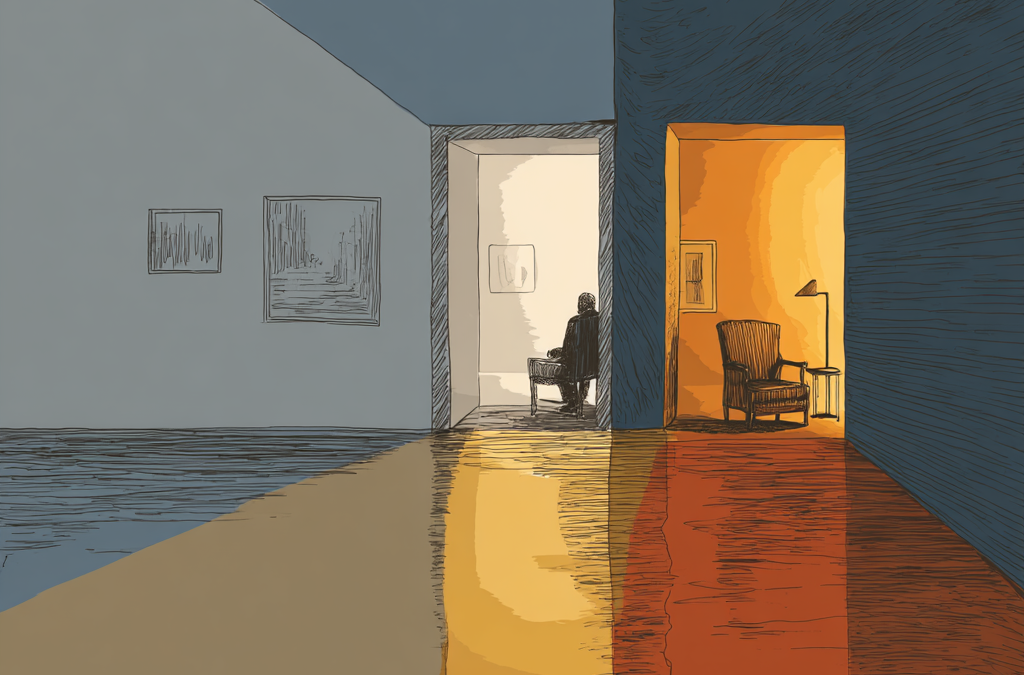
Three Rooms
On counselling, psychoanalysis and the Duo Coaching Framework
When a couple decides to seek help for their relationship, they rarely know what kind of room they are walking into. The word therapy covers an enormous range of traditions, each with its own assumptions about what a relationship is, what gets in its way, and how change happens. Three of those traditions sit very differently in the imagination, and it is worth setting them alongside one another — not to declare a winner, but to make the choices visible.
The counselling room
In a typical counselling room, a single practitioner sits with one or both partners for fifty minutes, usually once a week, for somewhere between six and twenty sessions. The work is largely conversational and present-focused. The counsellor listens, reflects, offers frameworks, and helps the couple find language for what has been happening between them. Counselling at its best is humane, accessible, and often genuinely useful. At its less good, it can become a weekly venting station — a regular hour in which the couple takes turns presenting evidence to a sympathetic referee, and then leaves without anything having materially shifted.
Counselling tends to assume that the couple’s difficulty is largely about communication and behaviour, and that with better tools and a kinder ear, they can find their way. Sometimes that is true. Sometimes the difficulty runs deeper than the tools can reach.
The analytic couch
Psychoanalysis works on a quite different assumption: that what is happening in any close relationship is shaped by patterns laid down long before the couple ever met, and that those patterns can only be reached slowly, through the gradual development of transference between client and analyst. The classical frame asks the client to attend four or five times a week, to lie on a couch facing away from the analyst, and to free-associate. The work typically lasts years — often a decade or more.
There is something to honour in this. Depth takes time. Some patterns really are old and deep and resistant to brisk reframing. The analytic tradition has produced extraordinary clinical writing and has shaped much of how we think about the unconscious mind. And yet a few questions are worth holding open. What does it cost — financially, and in terms of organising one’s life — to attend a consulting room five mornings a week for ten years? What does it do to a person to spend that long inside a relationship that is, by design, asymmetrical: the client revealing everything, the analyst withholding even the ordinary reciprocity of being looked at? And in a model built around individual analysis, where does the actual partner sit? Often, not in the room at all.
The frame protects something. It also produces something. Both deserve attention.
The Duo Coaching room
The Duo Coaching room looks different from either of the above. There are two practitioners present, not one. The session is longer — typically two to three hours rather than fifty minutes. The cadence is intensive but bounded: the work happens over weeks and months, not years, and the explicit aim from the first session is to equip the couple to leave.
Two practitioners in the room changes the field in ways that are difficult to appreciate until you have sat in it. One can attend to what is being said while the other notices what is happening in the body, the breath, the glance away. The practitioners can model dialogue between themselves — disagreeing kindly, repairing in real time, demonstrating the very things the couple has come to learn. Each partner has someone holding their perspective without being captured by it. The asymmetry of the lone-therapist room, in which one professional adjudicates between two people, dissolves.
The longer session length matters too. Real relational shifts rarely happen in the first forty minutes of conversation; they tend to surface once the surface arguments have been worked through and something more honest emerges. Fifty-minute sessions often end exactly at the moment the work was about to begin. A two- or three-hour session has time to go somewhere, and to bring the couple back before they leave.
And the endpoint is built in. The Duo Coaching Framework rests on six elements — Communication, Connection, Commitment, Fun, Growth and Trust — which are worked through with the couple as a shared vocabulary they take with them. The aim is not the indefinite continuation of the therapeutic relationship; the aim is for the couple to develop the capacity to do this work themselves, with each other, for the rest of their lives.
What is being chosen
These three rooms reflect three different theories of what a relationship is and what helps it. Counselling treats relationship difficulty largely as a problem of skills and communication. Psychoanalysis treats it as the surfacing of much older material that requires long, slow, individual excavation. Duo Coaching treats it as a living field between two people that can be held, witnessed, and reshaped intensively, with the couple themselves as the unit of work and the unit of change.
There are couples for whom each of these is the right answer. The question worth asking, before walking into any room, is a simple one: what is being assumed here about what I need, how long I will need it, and what success will look like when we are done?
A relationship is not a symptom. It is the place where two whole people meet. The room in which you choose to do that work shapes what becomes possible.